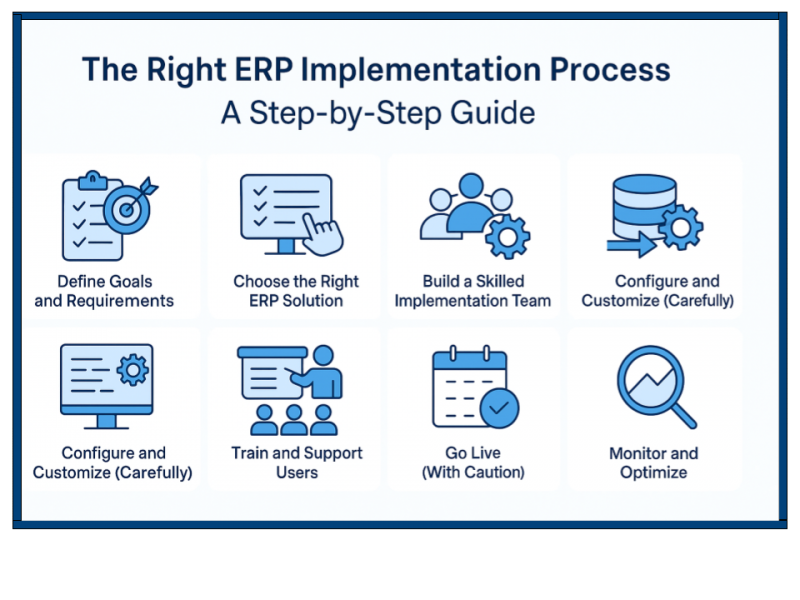
The Right ERP Implementation Process: A Step-by-Step Guide
Implementing an ERP system is far more than installing new software — it’s a strategic shift in how your organization operates. When executed properly, ERP centralizes business functions, boosts efficiency, and delivers real-time insights that support smarter decisions. Achieving this requires a structured and well-planned implementation approach.
Below is a refined breakdown of the right ERP implementation process every business should follow:
1. Define Clear Objectives and Requirements
Every successful ERP journey starts with understanding the purpose behind the implementation. Businesses must identify the challenges they want to solve — such as automating manual processes, improving inventory accuracy, enhancing financial reporting, or strengthening customer service.
Setting clear, measurable goals provides a strong foundation for the entire project.
2. Choose the ERP Solution That Fits Your Business
ERP solutions vary widely, and selecting the right one is critical. Whether choosing ERPNext, Odoo, SAP, Oracle, or an industry-specific system, the decision should align with your workflows, business size, and future growth plans.
Scalability, integration capabilities, user experience, and vendor reliability are essential factors during selection.
3. Build a High-Performance Implementation Team
A successful ERP rollout depends largely on teamwork. The implementation team should include IT professionals, department heads, process owners, and end-users who understand day-to-day operations.
A coordinated, cross-functional team ensures smooth execution and minimal disruption.
4. Plan and Execute Data Migration Carefully
Data migration is one of the most sensitive steps in ERP implementation. Moving outdated, inconsistent, or unstructured data into the new system can create long-term issues and reduce user confidence.
Cleaning, organizing, and validating data before migration is essential to ensure accuracy.
5. Configure and Customize Wisely
ERP systems come with powerful built-in features, but customization may still be required to match business processes. The challenge is to strike the right balance — too much customization increases complexity and makes future upgrades difficult.
Focus on leveraging standard features and only customizing when it truly adds value.
6. Train Users for Smooth Adoption
The success of an ERP system depends heavily on user adoption. Without adequate training, employees may feel overwhelmed or revert to old processes.
Comprehensive role-based training and hands-on practice ensure that users are comfortable and confident with the new system.
7. Go Live with a Controlled Strategy
Businesses can choose between a phased rollout or a full “big bang” launch.
A phased approach allows gradual transition and reduces risk.
A full rollout provides immediate organization-wide alignment.
Conducting a pilot launch before going live helps identify any gaps or issues early.
8. Continuously Monitor, Review, and Improve
ERP implementation is not a one-time event. After going live, continuous monitoring, system reviews, and feedback collection are essential.
Regular evaluations ensure that the ERP evolves with the business, supports new goals, and delivers ongoing improvements in productivity and customer satisfaction.
Below is a refined breakdown of the right ERP implementation process every business should follow:
1. Define Clear Objectives and Requirements
Every successful ERP journey starts with understanding the purpose behind the implementation. Businesses must identify the challenges they want to solve — such as automating manual processes, improving inventory accuracy, enhancing financial reporting, or strengthening customer service.
Setting clear, measurable goals provides a strong foundation for the entire project.
2. Choose the ERP Solution That Fits Your Business
ERP solutions vary widely, and selecting the right one is critical. Whether choosing ERPNext, Odoo, SAP, Oracle, or an industry-specific system, the decision should align with your workflows, business size, and future growth plans.
Scalability, integration capabilities, user experience, and vendor reliability are essential factors during selection.
3. Build a High-Performance Implementation Team
A successful ERP rollout depends largely on teamwork. The implementation team should include IT professionals, department heads, process owners, and end-users who understand day-to-day operations.
A coordinated, cross-functional team ensures smooth execution and minimal disruption.
4. Plan and Execute Data Migration Carefully
Data migration is one of the most sensitive steps in ERP implementation. Moving outdated, inconsistent, or unstructured data into the new system can create long-term issues and reduce user confidence.
Cleaning, organizing, and validating data before migration is essential to ensure accuracy.
5. Configure and Customize Wisely
ERP systems come with powerful built-in features, but customization may still be required to match business processes. The challenge is to strike the right balance — too much customization increases complexity and makes future upgrades difficult.
Focus on leveraging standard features and only customizing when it truly adds value.
6. Train Users for Smooth Adoption
The success of an ERP system depends heavily on user adoption. Without adequate training, employees may feel overwhelmed or revert to old processes.
Comprehensive role-based training and hands-on practice ensure that users are comfortable and confident with the new system.
7. Go Live with a Controlled Strategy
Businesses can choose between a phased rollout or a full “big bang” launch.
A phased approach allows gradual transition and reduces risk.
A full rollout provides immediate organization-wide alignment.
Conducting a pilot launch before going live helps identify any gaps or issues early.
8. Continuously Monitor, Review, and Improve
ERP implementation is not a one-time event. After going live, continuous monitoring, system reviews, and feedback collection are essential.
Regular evaluations ensure that the ERP evolves with the business, supports new goals, and delivers ongoing improvements in productivity and customer satisfaction.